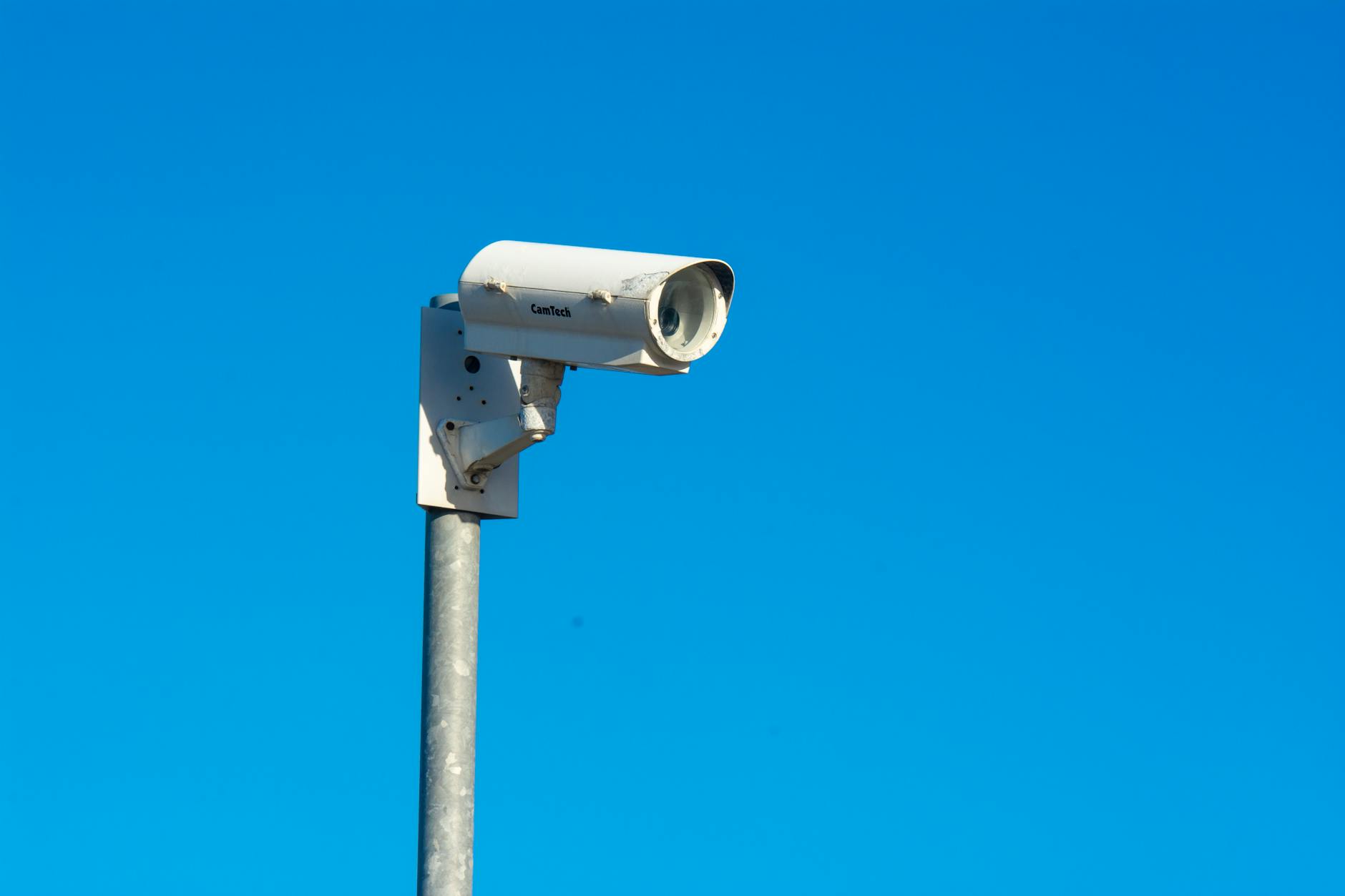
Why Does Border Surveillance Need Infrared Thermal Imaging?
The core value of border surveillance infrared thermal imaging is straightforward: it does not rely on visible light. Instead, it forms images from the target’s own thermal radiation. People, vehicles, animals, and engine heat sources can still be detected at night, under backlight, in weak illumination, or in moonless conditions. These capabilities match the real operating conditions of long border lines: limited lighting, wide patrol intervals, remote locations, and a high cost for missed events or false alarms.
What Problems Does Border Surveillance Infrared Thermal Imaging Solve?
Visible-light cameras need sunlight, artificial illumination, IR fill light, or moonlight. Thermal cameras mainly operate in the 8–14 μm LWIR band or the 3–5 μm MWIR band. Human skin surface temperature is typically around 30–36°C. Using 300 K as an approximate reference, the peak of human thermal radiation is about 9.7 μm, which falls directly within the long-wave infrared range. This is why uncooled LWIR thermal cameras are well suited to night-time personnel detection, while cooled MWIR cameras are preferred for longer-range and higher-sensitivity applications.
In border areas, thermal imaging is commonly used for three target classes: pedestrians, off-road vehicles, and slow-moving boats. For example, with a typical 640×512, 12 μm detector paired with a 75 mm lens, the instantaneous field of view is about 0.16 mrad. At 1 km, a 1.7 m tall person occupies roughly 10 pixels in height. At 3 km, the same person occupies about 3–4 pixels in height. However, real “detection, recognition, and identification” range is affected by lens focal length, NETD, humidity, rain, fog, background temperature difference, and analytics performance. It should never be judged by detector resolution alone.
A practical border security system usually links thermal imaging with visible-light video, pan-tilt units, radar, vibration fiber, or other perimeter sensors. A single isolated camera rarely provides the reliability needed for a long, unmanned border segment.
How Does Infrared Thermal Imaging Work at Night and in Bad Weather?
Thermal imaging is not a universal see-through technology, but it has a clear advantage in low-light and low-contrast scenes. Visible cameras can lose the target completely when there is no illumination. Thermal cameras look for temperature contrast, so a person moving across grass, soil, a fence line, or a hillside can still create a usable silhouette.
From an engineering perspective, three specifications deserve close attention: NETD, spatial resolution, and lens focal length. NETD ≤50 mK is a common baseline for many projects, while NETD ≤30 mK is more suitable for scenes with low temperature contrast. A 640×512 detector can cover many mid-range perimeter points. A 1280×1024 detector is better when the system must scan a wider area or retain detail after electronic zoom. Longer focal lengths increase target pixels at long distance, but they narrow the field of view, so pan-tilt scanning or multiple installation points may be needed to avoid blind zones.
For fixed towers, port perimeters, and unattended border posts, the SPECTRA L06A 640×512 LWIR 12μm is a practical uncooled LWIR module for baseline thermal coverage. If the target distance is longer, the background contrast is weaker, or higher frame rate and sensitivity are required, a cooled MWIR module such as the SPECTRA M06A 640×512 Cooled MWIR 15μm should be evaluated.
Weather still matters. Light fog, weak smoke, and low illumination usually affect visible-light cameras more severely than thermal imagers. Heavy rain, dense fog, and high humidity can attenuate infrared radiation and reduce effective range. Procurement specifications should therefore define performance under expected local conditions instead of relying only on ideal laboratory figures.
How Do Thermal Cameras, Visible Cameras, and AI Reduce False Alarms?
The largest engineering challenge in border alarm systems is often not “Can we see something?” but “Can we keep false alarms under control?” Moving branches, animals, heat shimmer, vehicle residual heat, and post-rain ground temperature differences can all trigger simple video motion detection. If the system relies only on motion in a thermal video stream, night-time false alarm rates are difficult to stabilize.
A more reliable architecture uses multi-source confirmation. Thermal imaging provides all-day detection. Visible-light imaging supports visual verification and evidence capture. AI classifies people, vehicles, animals, and other objects. A dual-band module such as FUSION LV1225A 1280×1024 + 2560×1440 can combine infrared target silhouettes with high-definition visible images, reducing the common problem of “a heat source is visible, but the operator cannot determine what it is.”
Edge-side AI is also important. Systems such as NEXUS LV0619B AI multi-band Ethernet/SDI are suitable for unattended locations because target detection, line crossing, intrusion-zone alarms, and trajectory filtering can run at the front end. This reduces backhaul bandwidth and lowers the processing burden on the central platform.
For acceptance testing, buyers should separate imaging performance from analytics performance. Thermal image quality can be evaluated through sensitivity, contrast, stability, non-uniformity correction, and lens suitability. AI alarms should be tested against target class, direction, speed, distance, background, and weather. Public references such as ISO 18434-1:2008, EMVA 1288, and ONVIF profiles can help structure technical requirements around thermography procedures, imaging measurement concepts, and system interoperability. They do not replace field trials, but they help procurement teams write clearer clauses for sensitivity, image output, operator workflow, and platform integration.
LWIR vs MWIR for Border Surveillance: Which Should You Choose?
LWIR and MWIR are not simply “low cost” versus “high end.” They solve different surveillance problems.
For 300–800 m perimeter blind-spot coverage, a 640×512 LWIR thermal camera with a 25–50 mm lens is usually the first option to evaluate. The priorities are cost, power consumption, IP protection, image stability, and compatibility with the video management platform. These sites are often numerous, so maintainability and unit cost matter as much as peak range.
For 1–3 km personnel detection, 640×512 or 1280×1024 LWIR should be considered with a 75–100 mm lens. A pan-tilt unit is often needed for sector scanning, especially when the field of view becomes narrow. At these distances, target pixel count becomes a hard constraint: a person must occupy enough pixels for the operator and AI algorithm to detect and classify the event reliably.
For longer-range vehicle or personnel detection, low-temperature-difference backgrounds, coastal monitoring, or high-value border sections, cooled MWIR should be evaluated. MWIR systems can provide higher sensitivity and stronger long-range capability, but budget, maintenance, cooler lifetime, startup time, and power supply requirements must all be included in the system design.
The conclusion is clear: border projects should not simply purchase the thermal camera that “sees farthest.” The correct design starts with target size, distance, field of view, local weather, false alarm requirements, and integration workflow. Field thermal testing should be completed before finalizing waveband, resolution, lens focal length, and AI strategy. Fixed posts can often start with uncooled LWIR. Long-range critical points may require cooled MWIR and dual-band fusion.
When to Use Border Surveillance Infrared Thermal Imaging in a Complete System
Thermal imaging is most valuable when the mission requires continuous detection rather than occasional visual confirmation. Typical use cases include unattended border sections, desert or mountain crossings, river and coastal boundaries, port perimeters, road checkpoints, and long fence lines. In these locations, lighting construction is expensive, patrol intervals are long, and targets may intentionally move at night.
The system design should define a complete alarm chain. A perimeter sensor or radar can cue the pan-tilt thermal camera. The thermal camera detects the target and tracks motion. The visible camera captures detail when lighting allows. AI filters target type and behavior. The command platform records the event, presents evidence, and supports graded response. Without this workflow, even a high-performance thermal imager can become another video feed that operators cannot monitor effectively.
Installation details are also critical. Towers should minimize vibration. Lens selection should match the required target pixel count. The camera should avoid hot exhaust, reflective surfaces, and repeated occlusion by vegetation. For long-range deployments, atmospheric conditions and ground heat should be tested at different times of day. In many border environments, the hardest scenes occur around sunrise, sunset, after rain, or when the background temperature is close to body temperature.
Procurement teams should ask suppliers for real field imagery at the target distance, not only datasheet detection claims. They should also request SDK, video interface, metadata, ONVIF compatibility, and alarm output details early in the process. A camera that performs well optically but cannot integrate into the command platform may increase project cost later.
FAQ
Q1: Can infrared thermal imaging see through rain and fog?
A: It cannot truly “see through” rain or fog. Thermal imaging is often better than visible light in light fog, weak smoke, and low illumination, but heavy rain, dense fog, and high humidity will attenuate infrared signals. Detection range expectations should be reduced under those conditions.
Q2: Should border surveillance use LWIR or MWIR thermal imaging?
A: For medium and short distances with continuous unattended operation, uncooled LWIR is usually preferred because cost and maintenance are lower. For long-distance detection, low-temperature-contrast scenes, and high-sensitivity missions, cooled MWIR is more suitable, but the system cost and maintenance requirements are higher.
Q3: Is 640×512 resolution enough for border monitoring?
A: It depends on target distance and lens focal length. 640×512 is sufficient for many perimeter points. If the system needs a wider field of view, more detail after electronic zoom, or better classification at distance, 1280×1024 is more appropriate.
Q4: Can AI completely replace human border monitoring?
A: No. AI is useful for reducing false alarms and classifying people, vehicles, and animals, but border applications should still keep human review, linked evidence capture, and graded response procedures.
Q5: What specifications matter most when buying a border thermal camera?
A: Start with target size, detection distance, lens focal length, NETD, resolution, field of view, weather conditions, AI false alarm performance, and platform integration. A field test at the intended distance is more reliable than selecting only by sensor resolution.